

How to Detangle Extensions Without Breakage
Table of Contents
- What You'll Need to Detangle Extensions Without Breakage
- Step-by-Step: How to Detangle Extensions Without Breakage
- How to Prevent Hair Extensions from Tangling
- Common Mistakes That Cause Matting and Shedding
Last Updated: August 24, 2026
What You'll Need to Detangle Extensions Without Breakage
The right tools prevent fiber damage. Gather these essentials:
- A wide-tooth comb for separating large sections and initial knots
- A loop brush or cushioned detangling brush with flexible bristles that bend rather than pull
- A detangling spray or leave-in conditioner to add slip and reduce friction
- A gentle hair tie or clip to section off hair as you work
- A spray bottle of water (for human hair extensions) to lightly dampen stubborn tangles
The most critical tool is your brush. Flexible bristles on a cushioned rubber base glide through knots without snagging the hair cuticle or stressing the attachment point. Stiff, paddle-style brushes cause shedding and breakage, skip them entirely for extension work.

Wooden Hair Brush for Detangling | Beech Wood Scalp Massage Brush | Wet Dry Brush for Curly Thick Fine Hair | Luxury Gift for Women
Tool |
Purpose |
Best For |
|---|---|---|
Wide-tooth comb |
Initial knot separation |
All extension types |
Cushioned detangling brush |
Gentle brushing, scalp massage |
Human hair and synthetic fibers |
Detangling spray |
Adds slip, reduces friction |
Dry or stubborn tangles |
Loop brush |
Glides through without catching |
Tape-ins, clip-ins, wefts |
Leave-in conditioner |
Moisture restoration, softening |
Human hair extensions |
Step-by-Step: How to Detangle Extensions Without Breakage
The bottom-to-top method prevents knots from compounding. Starting at the roots forces tangles deeper; working from ends upward dissolves each knot progressively.
- Section your hair into two to four manageable parts using clips.
- Apply detangling spray generously from mid-shaft to ends. For human hair, a light mist of water first helps product distribute evenly.
- Start at the ends with your wide-tooth comb using a gentle raking motion through the bottom two to three inches until that section moves freely.
- Move upward in increments of two to three inches, working through each new section before advancing toward the root.
- Switch to your cushioned detangling brush once major knots are cleared, using smooth, controlled strokes.
- Hold the hair above the section you're working on with your free hand to absorb tension so it doesn't travel to the attachment point.
- Finish with a light pass from root to tip once the section is fully tangle-free.
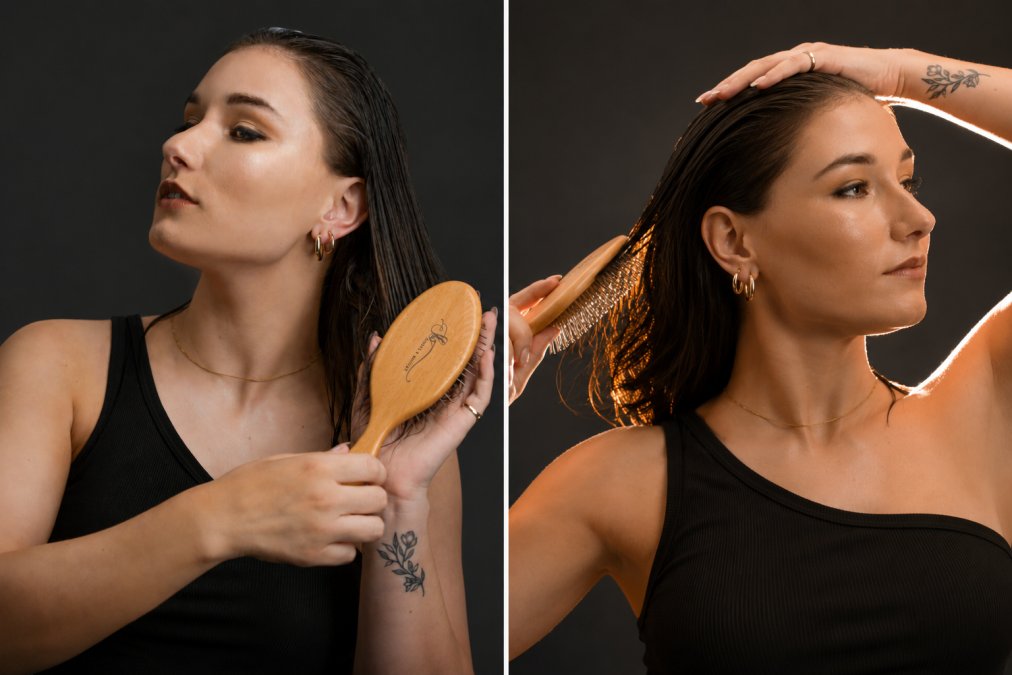
Close-up of a woman's hands gently brushing hair extensions from ends to roots using a cushioned detangling brush on a vanity surface, soft natural lighting
Wet vs. dry extensions: Human hair extensions can be detangled both wet and dry, though slightly damp hair with leave-in conditioner works best. Synthetic extensions should be detangled dry, since water causes fibers to swell and tangle further (peer-reviewed research). According to American Academy of Dermatology guidance on hair care, excessive tension during brushing is a leading contributor to mechanical breakage, which is why the bottom-to-top technique protects both natural hair and extension fibers.
How to Prevent Hair Extensions from Tangling
Prevention stops the cycle of reactive detangling and breakage:
- Braid or loosely plait your extensions before sleeping on a satin or silk pillowcase to reduce friction.
- Apply leave-in conditioner or lightweight oil to mid-lengths and ends every two to three days. Human hair extensions don't receive natural sebum from the scalp.
- Brush before washing, not after. Wet hair is more fragile; working out tangles while dry reduces breakage.
- Avoid high-heat styling without a heat protectant. Heat damage roughens the cuticle, creating barbs that catch on neighboring strands.
- Rinse extensions in a downward direction. Never scrub or pile extensions on top of your head, circular motion creates knots.
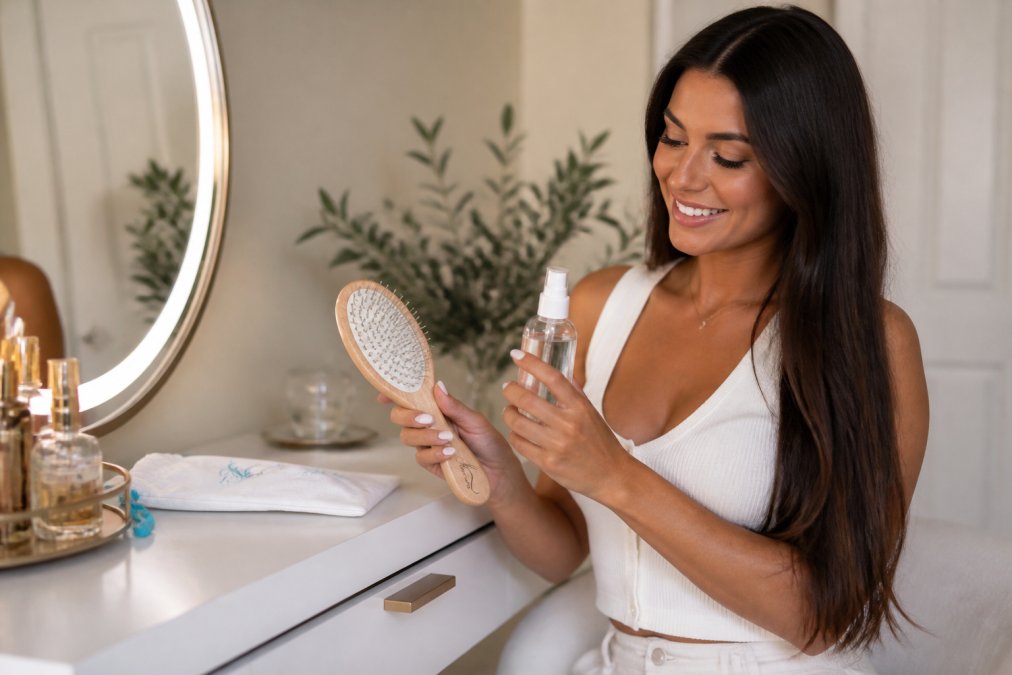
A woman with long, smooth, tangle-free hair extensions sitting at a vanity, holding a luxury detangling brush and a small bottle of detangling spray, warm ambient lighting
A DIY detangling solution: equal parts water and lightweight conditioner in a spray bottle makes an effective alternative to commercial sprays without silicone buildup.
The Simply Boujie Beech Wood Detangling Brush ($44.95) features rounded metal pins on a cushioned base that flex through knots rather than catching on them, safe for wet and dry styling, extensions, and wigs.
Common Mistakes That Cause Matting and Shedding
Most matting problems stem from repeated habits that compromise hair structure:
Starting at the roots compresses knots downward. Always work bottom-to-top. Skipping detangling spray creates friction that roughens the cuticle. Brushing too aggressively causes damage; a gentle raking motion is always more effective. Neglecting the nape and underneath layers leaves vulnerable areas prone to tangling. Using the wrong brush type creates scalp tension and catches on attachment points. Extension-safe brushes with flexible bristles and cushioned bases are essential.
According to hair health research from the National Institutes of Health, repeated friction and tension cause cumulative structural damage that compounds over time.
Matting and breakage are largely preventable with the right tools and technique. Simply Boujie's extension-safe detangling brushes, including the Pearl White and Matte Black styles at $39.95 each, feature cushioned bases and flexible bristles that protect both natural hair and extension fibers. Shop Simply Boujie and make tangle-free hair part of your daily ritual.


Frequently Asked Questions
Q: How often should I brush my extensions to prevent tangling?
A: Brush your extensions at least twice a day — once in the morning and once before bed. Before sleeping, loosely braid them or tie them in a low ponytail to reduce friction against your pillow. Extensions tangle faster than natural hair because they lack the scalp's natural oils traveling down the hair shaft, so a consistent brushing routine is an effective form of preventative care for long-term hair health and longevity.
Q: What is the best detangler for hair extensions?
A: For human hair extensions, a lightweight leave-in conditioner or a water-based detangling spray works best. Apply it to dry or damp hair before brushing, focusing on the mid-lengths and ends where matting forms first. Avoid heavy oils near weft or bond attachment points, as buildup can weaken them. For synthetic fibers, use a product specifically formulated for synthetic hair — standard conditioners can coat the fibers and create more friction over time.
Q: Can you fix matted extensions without ruining them?
A: Yes, most matted extensions can be rescued if you work patiently. Saturate the matted section with a detangling spray or diluted conditioner and let it absorb for a few minutes. Then use a wide-tooth comb or a cushioned extension-safe brush to gently work through the knot from the ends upward, never pulling from the root. Rushing this process causes breakage and shedding. Severe matting near attachment points may need a professional stylist to address safely.
This article was written using GrandRanker